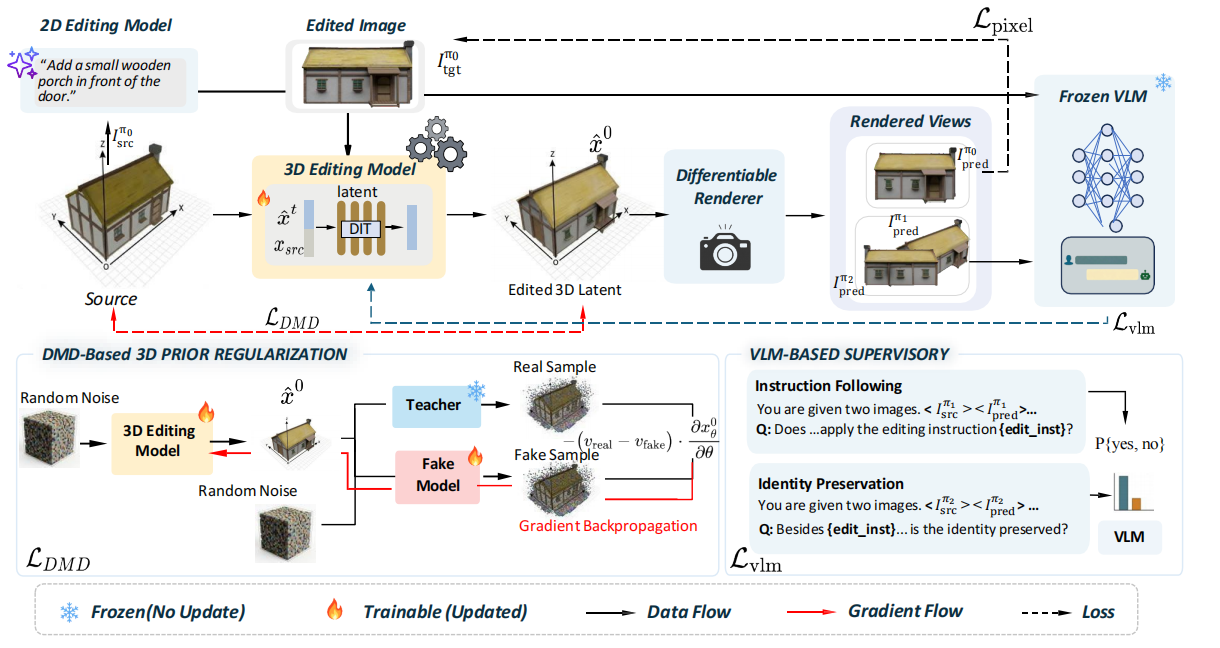
Instruction-guided 3D editing is essential for interactive content creation, yet it faces a significant
bottleneck: the severe scarcity of high-quality paired training data. Existing approaches attempt to
bypass this by either relying on slow test-time optimization or training on pseudo-pairs constructed via
complex pipelines, which often introduce structural drift and geometric artifacts. In this paper, we
propose a novel framework that learns feed-forward 3D editing without paired 3D supervision via
Generative Prior Distillation. Instead of relying on ground-truth 3D pairs, our core
idea is to distill visual, semantic, and geometric knowledge from powerful foundation models directly into
a 3D editing model. Specifically, through a differentiable rendering pipeline, we supervise the 3D
representation using two complementary signals: a 2D visual prior from an image editing
model at the main editing view, and a semantic prior from a Vision-Language Model at
novel views to ensure strict instruction following and source identity preservation. Crucially, to address
the geometric collapse and multi-view inconsistencies inherent in 2D projection supervision, we introduce
a 3D-aware Distribution Matching regularization. Acting as a geometric prior, this term
operates in the 3D latent space, constraining the edited output to remain within the manifold of realistic
3D assets defined by a pretrained image-to-3D teacher model. Extensive experiments demonstrate that our
method achieves superior instruction fidelity and cross-view consistency, significantly outperforming
state-of-the-art baselines.